

If you’ve been keeping an eye on loan EMIs, FD rates, or the overall mood of the economy, the latest RBI policy update is important—even though it comes with a familiar headline.
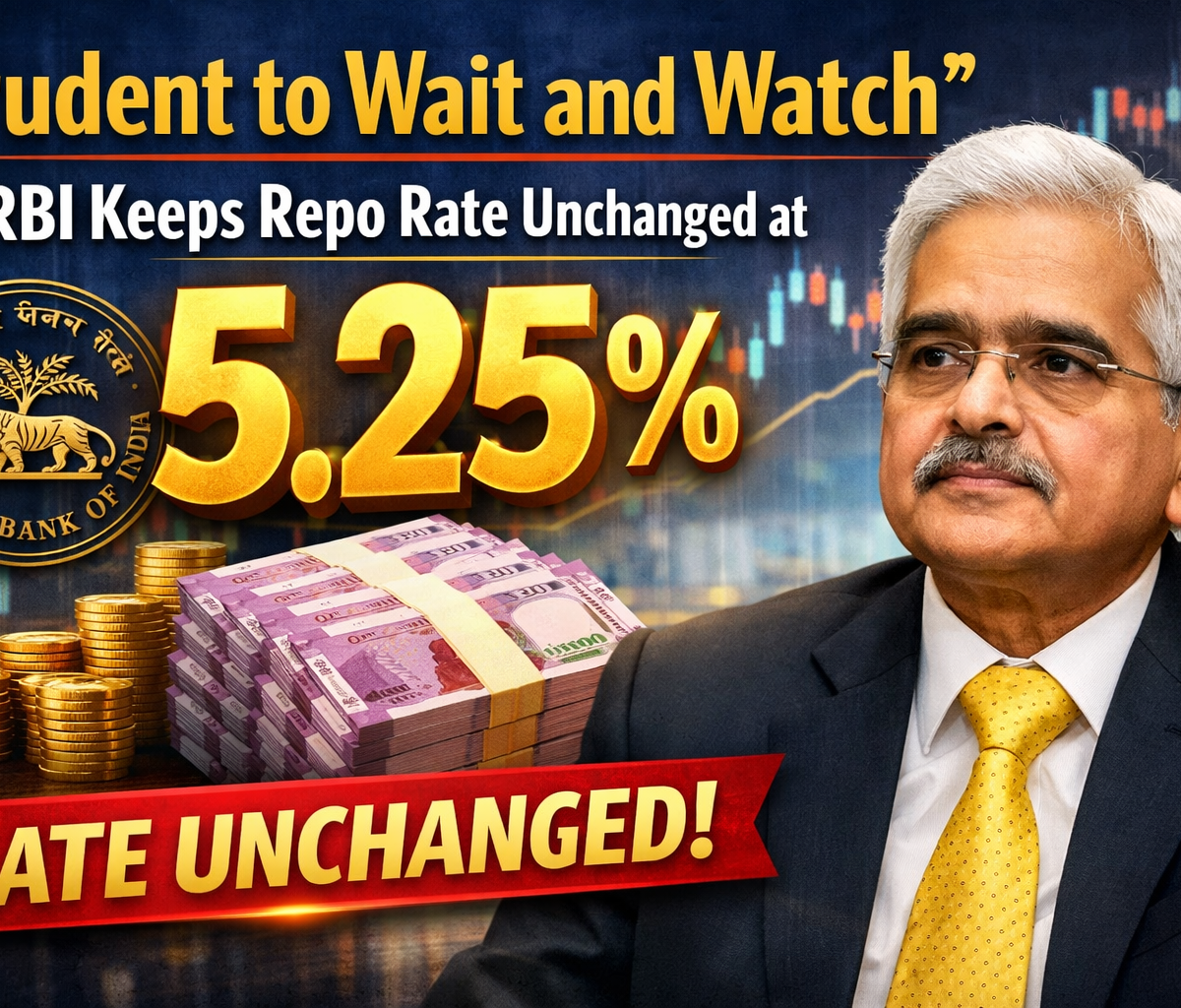
In the latest Monetary Policy Committee (MPC) decision, the RBI kept the repo rate unchanged at 5.25%, aligning with what most analysts and market participants expected. The six-member committee took the decision unanimously after two days of deliberations under RBI Governor Sanjay Malhotra.
You can always catch more updates like this on Newzeefy here: newzeefy.com.
RBI MPC Decision: Repo Rate Held at 5.25%
The RBI’s MPC meets every two months to review inflation trends, growth outlook, global risks, and financial conditions. Based on the latest assessment, the central bank decided it’s best to hold rates steady and continue a cautious stance.
Key takeaway
- Repo rate remains: 5.25%
- Decision: Unanimous
- RBI stance: “Prudent to wait and watch”
This isn’t the first time the RBI has paused. The central bank had also kept the policy rate unchanged in previous meetings (including August, October, and February 2026), reinforcing the idea that it prefers stability while risks remain elevated.
For more India economy and market-moving headlines, you can browse: Trending News – Latest.

Why This RBI Announcement Came at a Sensitive Global Moment
This repo rate decision landed just hours after a major geopolitical development: US President Donald Trump announced a “double-sided ceasefire” with Iran. That two-week truce helped global markets rally, and Indian benchmark indices opened with a gap-up too.
But the RBI doesn’t set policy based on one day’s market optimism. It looks at bigger, longer-term risks—especially those tied to:
- energy prices (crude oil),
- global growth,
- inflation pressures,
- currency stability.
In short, even if markets breathe easier today, the RBI is planning for what might happen next.
What RBI Governor Sanjay Malhotra Highlighted
The RBI Governor’s commentary painted a picture of strength with caution—India’s fundamentals look solid, but external shocks can change the outlook quickly.
Major points from the RBI Governor’s remarks
- India’s macro-economic fundamentals are robust, though conditions got challenging in March due to the Iran war situation.
- Global growth faces risks because of rising energy prices.
- Uncertainty from conflict can weigh on the economic outlook.
- Equities saw a broad-based correction amid heightened uncertainty.
- India’s forex reserves remain healthy at $697.1 billion.
- Merchandise exports fell 0.2% year-on-year during the first two months of this year.
If you’re following business and policy developments closely, you’ll find more related coverage here: Business News – Latest.
RBI GDP Forecast: Growth Seen Easing Slightly to 6.9% in FY27
One of the most watched parts of any RBI policy is its growth projection. This time, the RBI projected FY27 Real GDP growth at 6.9%, factoring in uncertainty and war-related risks.
RBI’s quarter-wise FY27 GDP projections
- Q1: 6.8%
- Q2: 6.7%
- Q3: 7.0%
- Q4: 7.2%
What this means in plain language
India is still expected to grow at a healthy pace, but the RBI is not ignoring global stress points. When crude oil prices rise or trade routes face disruption, it can hit demand, raise costs for businesses, and slow momentum.
The Core Reason RBI Didn’t Change Rates: Inflation Is Calm, But Risks Are Not
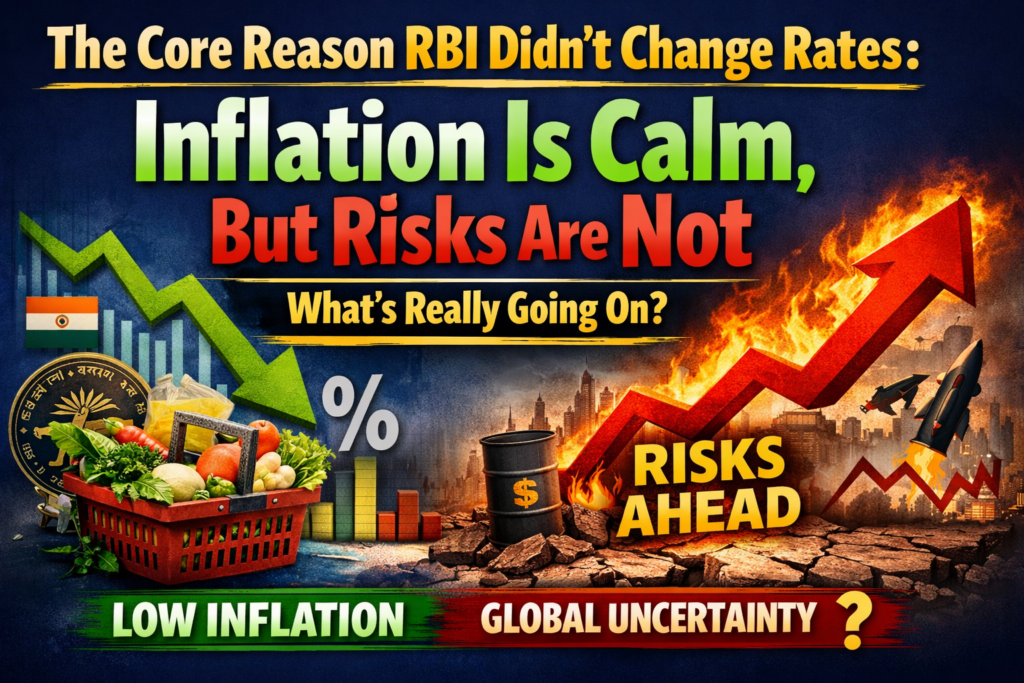
Inflation is the RBI’s biggest concern, and right now it looks relatively contained. The RBI acknowledged that headline inflation is below its 4% target, which is encouraging.
But it also clearly flagged upside risks—meaning inflation could climb again if certain triggers flare up.
RBI’s inflation-related concerns
- Food price risks: Weather disturbances can disrupt supply and push food inflation up.
- Crude oil risk: Costlier fuel can raise transportation and production costs.
- Uncertainty factor: Conflict-driven volatility can affect multiple inputs, especially energy.
This is why the RBI used a cautious phrase like “prudent to wait and watch.” It’s essentially saying: inflation is okay today, but we don’t want to make a move that could backfire if prices surge again.
Why Crude Oil Prices Matter So Much to RBI Policy
Crude oil has a direct line to inflation and India’s external stability. When crude prices rise sharply:
- fuel becomes expensive,
- logistics costs rise,
- many goods become pricier,
- and the trade deficit can widen.
The RBI also warned that high crude prices may widen the current account deficit (CAD).
Quick breakdown: How high crude affects India
- Inflation goes up (fuel + transport + manufacturing costs)
- CAD widens (India pays more for imports)
- Rupee faces pressure (higher demand for dollars to pay for oil)
So even if inflation is currently below target, the RBI is being careful—because a crude shock can change the story quickly.
Forex Reserves: India’s Strong Buffer in Uncertain Times
One reassuring highlight: India’s forex reserves are at $697.1 billion, which signals strong external resilience.
Why forex reserves matter to you (even if you don’t trade currency)
Healthy reserves help the country manage:
- sudden spikes in oil prices,
- foreign investor outflows,
- rupee volatility,
- global financial stress.
This is one reason the RBI can afford to be patient. A strong reserve position provides breathing room when the world gets unpredictable.

MSME Boost: RBI Suspends Due-Diligence Requirement for Trade Platforms
Along with the repo rate decision, the RBI also announced a business-friendly move: suspending due-diligence requirements for MSMEs for inclusion in various trade platforms, to promote ease of doing business.
Why MSMEs may welcome this change
- Less friction to join trade platforms
- Faster onboarding and compliance ease
- Better access to market opportunities
This step matters because MSMEs are a key engine of employment and domestic production—exactly the kind of support that helps growth stay steady even when global conditions are shaky.
What an Unchanged Repo Rate Means for Common People
A repo rate pause may sound boring, but it affects real-life money decisions—especially borrowing and saving.
1) Home loan and personal loan borrowers
If your loan is linked to external benchmarks, a steady repo rate usually means:
- EMIs stay stable (unless the bank changes spreads or resets terms)
2) Fixed deposit (FD) savers
- FD rates may not change immediately.
- If the RBI continues to hold, banks tend to keep deposit rates steady too.
3) Business owners and entrepreneurs
- Borrowing costs become more predictable.
- Planning expansion becomes easier when rates aren’t moving every policy cycle.
For more updates that connect policy decisions to daily life, you can also explore Newzeefy’s broader coverage:
- Technology News – Latest (how policy impacts industries and markets)
- AI News – Latest (AI, business productivity, and economic trends)
- Gadgets – Latest (consumer spending often reflects economic confidence)
What to Watch Before the Next RBI Policy Meeting
The RBI is clearly waiting for more clarity. Here are the biggest triggers that could influence the next decision:
Key things that may push RBI to rethink
- Crude oil movement: Sustained rise could worsen inflation and CAD
- Food inflation signals: Monsoon progress and crop supply
- Global conflict updates: Any renewed tensions can spike energy prices
- Exports and trade: A prolonged slowdown could hurt growth
- Domestic demand: Consumption and investment trends matter
External Reference: Where to Read Official RBI Updates
If you want the official source directly from the central bank, you can check the RBI’s website here: Reserve Bank of India (Official Website).
Conclusion: RBI Chooses Stability, But Keeps Its Guard Up
By keeping the repo rate unchanged at 5.25%, the RBI is prioritizing stability while staying alert. Inflation may be under control for now, but the central bank is not ignoring the risks of:
- higher crude oil prices,
- food inflation shocks,
- global uncertainty affecting growth and trade.
For borrowers, this pause may mean steadier EMIs. For savers, it suggests deposit rates may not swing abruptly. And for businesses—especially MSMEs—the RBI’s additional ease-of-doing-business move could provide meaningful support.
For more daily updates across policy, markets, jobs, tech, and trends, visit newzeefy.com—and if you’re tracking employment and hiring news too, check: Latest Jobs.