

Best AI Tools 2026 are already transforming how people work, study, create content, and run businesses. Best AI Tools 2026 are not just experimental software anymore—they are becoming everyday digital assistants used by student, developer, entrepreneurs, and professionals across the world.
At this point, you may be feeling a bit lost as AI is constantly evolving so much with new platforms popping up every month claiming to be more productive, automated, or a time-saver.
So, which of these tools will really mean something by 2026?
This guide provides a breakdown of the Top AI Tools for 2026 (what they are used for), examples of these tools in the real world, and how to decide which of these AI tools will actually help improve your productivity.
For more technology insights and digital trends, you can explore helpful resources at.
🔑 Key Highlights
- Best AI Tools 2026 improve productivity across many industries
- AI tools assist with writing, coding, research, and automation
- Businesses use AI tools to reduce costs and improve efficiency
- Students rely on AI assistants for studying and research
- AI-powered platforms can generate images, videos, and code
- The AI software market is expected to exceed $1 trillion by 2030
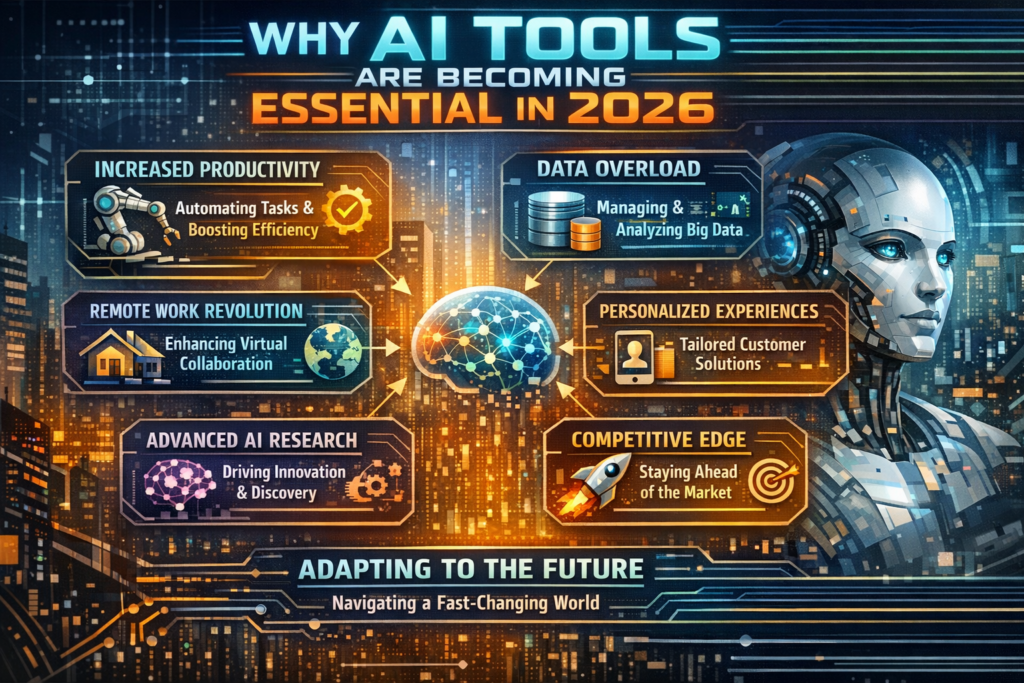
Why AI Tools Are Becoming Essential in 2026
Artificial intelligence tools have moved far beyond research labs.
Today they help people with tasks like:
- writing emails
- generating blog posts
- analyzing data
- coding software
- designing graphics
- automating business processes
According to reports from the World Economic Forum, AI adoption in workplaces is growing rapidly as companies search for ways to improve efficiency and innovation.
For professionals and students, learning how to use the Top AI tools 2026 is becoming an important career skill.
1. ChatGPT – The Ultimate AI Productivity Assistant
One of the most popular tools in the Best AI Tools 2026 list is ChatGPT.
It helps users:
- generate articles
- debug code
- summarize documents
- answer complex questions
- brainstorm ideas
Real-world use case
Developers often use ChatGPT as a coding assistant. Instead of searching multiple documentation pages, they ask the AI to explain errors or generate example code.
Students use it to understand complex topics faster.
2. Google Gemini – AI Integrated with Search and Apps
Another powerful tool in the Top AI tools 2026 category is Google Gemini.
Gemini connects deeply with the Google ecosystem.
It can assist with:
- research
- writing
- coding
- document summaries
- Google Docs and Gmail productivity
Why professionals like it
People who already work inside Google tools often find Gemini extremely convenient.
3. Midjourney – AI Image Creation Tool 🎨
Visual creators rely heavily on Midjourney.
This AI tool can generate highly detailed images from simple text prompts.
Designers use it for:
- concept art
- marketing graphics
- product visualization
- social media content
AI image generation is rapidly changing the creative industry.
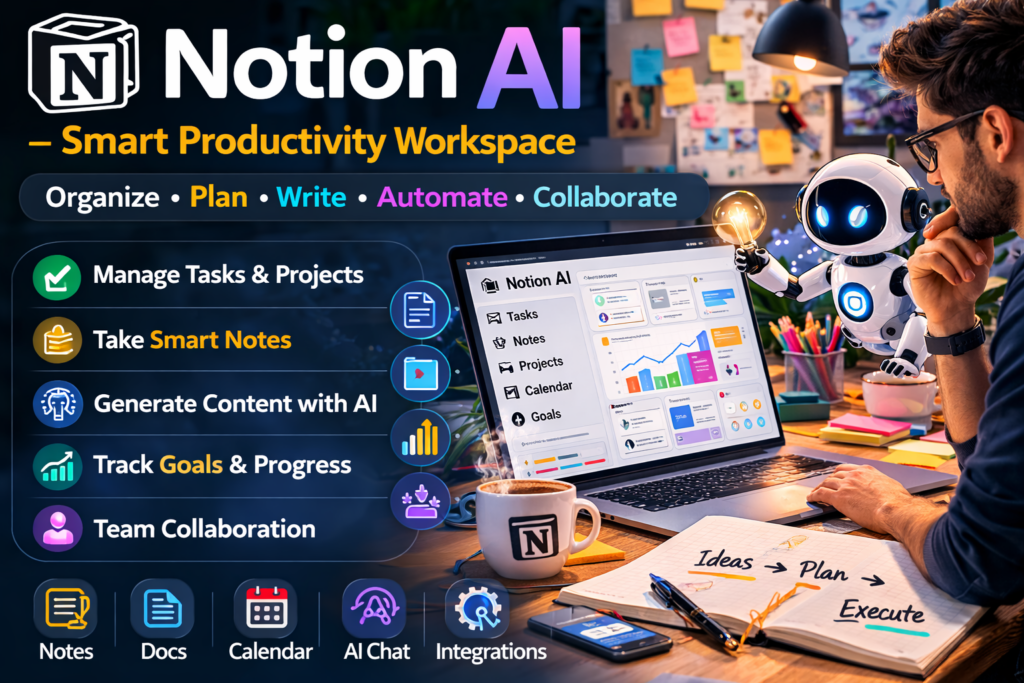
4. Notion AI – Smart Productivity Workspace
Notion AI combines note-taking, project management, and AI writing.
Users rely on it to:
- organize tasks
- summarize notes
- generate meeting summaries
- brainstorm ideas
Startups and remote teams often use Notion AI to manage projects efficiently.
5. Grammarly – AI Writing Assistant
Writing is still one of the most common digital tasks.
Grammarly helps improve:
- grammar
- tone
- clarity
- readability
Many professionals use Grammarly while writing emails, reports, and academic papers.
6. GitHub Copilot – AI for Developers
Coding productivity has improved dramatically thanks to GitHub Copilot.
Copilot suggests code in real time while developers write programs.
Benefits include:
- faster development
- fewer syntax errors
- automated code suggestions
Many software engineers describe it as “pair programming with AI.”
7. Jasper AI – Marketing and Content Creation
Content creators often rely on Jasper AI.
It helps generate:
- marketing copy
- ad headlines
- blog outlines
- email campaigns
Businesses use Jasper AI to scale content production.
8. Runway ML – AI Video Generation
Video creators are increasingly using Runway ML.
This tool allows creators to:
- generate video from text prompts
- remove backgrounds
- edit video automatically
AI video generation is becoming one of the fastest-growing creative technologies.
9. QuillBot – AI Writing and Paraphrasing Tool
Students often rely on QuillBot for writing assignments.
It helps:
- paraphrase sentences
- summarize articles
- improve writing clarity
This makes academic writing easier for many students.
10. Canva AI – AI Graphic Design Tool
Graphic design no longer requires advanced software skills.
Canva now includes powerful AI features.
Users can:
- generate designs
- create social media graphics
- design presentations
This tool is extremely popular among marketers and content creators.
How Professionals Use the Best AI Tools 2026
AI tools are not just for tech experts.
Many industries are adopting them.
Students
Students use AI tools to:
- summarize textbooks
- research information
- improve writing
Developers
Developers rely on AI for:
- debugging code
- generating scripts
- explaining algorithms
Businesses
Companies use AI tools to:
- automate marketing
- analyze data
- improve customer support
Best Practices When Using AI Tools
AI tools can be powerful, but they must be used responsibly.
1. Always verify information
AI systems sometimes produce incorrect facts.
Always double-check important data using trusted sources.
2. Use AI to support creativity
AI tools work best when they assist human creativity rather than replace it.
For example:
- brainstorm ideas
- refine drafts
- analyze data
3. Combine multiple AI tools
Many professionals combine several AI tools.
Example workflow:
- research using Gemini
- write drafts using ChatGPT
- edit text with Grammarly
- create visuals using Midjourney
This approach increases productivity.
The Future of AI Tools
The growth of AI tools shows no sign of slowing down.
Experts predict major advances in:
- multimodal AI systems
- AI assistants integrated with everyday apps
- AI-driven research tools
- autonomous digital agents
By 2030, AI tools may become standard workplace companions for most professionals.
Internal Resources on Newzeefy
Explore more insights on technology at Newzeefy:
These guides help readers understand technology trends, AI tools, and digital transformation.
Final Thoughts
Digital technology today includes many elements, but in the coming year, artificial intelligence (AI) could dominate the digital landscape. The top AI technologies for 2026 provide users with tools to be more productive, efficient learners, and able to develop innovative solutions for problems that exist today or will be solved in the future.
The most intelligent way to approach AI technologies is by learning how to harness them effectively, as people who utilize AI applications in 2026 will have an edge over those who do not.
There will be continued advances in technology, and the use of AI will play a significant role in how we perform our jobs and how we express ourselves creatively in the future.
For more technology insights and digital innovation news, visit newzeefy.
Frequently Asked Questions (FAQ)
What are the best AI tools in 2026?
The Best AI Tools 2026 include popular platforms such as ChatGPT, Google Gemini, Midjourney, Notion AI, Grammarly, GitHub Copilot, Jasper AI, Runway ML, QuillBot, and Canva AI. These tools help users with writing, coding, design, research, and productivity.
Why are AI tools important in 2026?
AI tools are important because they help people work faster, automate repetitive tasks, analyze large amounts of data, and improve creativity. Many businesses and professionals now rely on Top AI tools 2026 to increase productivity and efficiency.
Which AI tool is best for students?
Students often use AI tools like ChatGPT for study assistance, Grammarly for writing improvement, Notion AI for note-taking, and QuillBot for paraphrasing and summarizing research materials.
Which AI tools are useful for developers?
Developers commonly use AI tools such as GitHub Copilot for coding support, ChatGPT for debugging code, and Google Gemini for technical research and documentation.
Are AI tools free to use?
Many AI tools offer free versions with limited features. However, premium plans usually provide advanced features, higher usage limits, and additional productivity tools.
How can businesses benefit from AI tools?
Businesses use AI tools to automate customer support, create marketing content, analyze business data, and improve decision-making. This helps companies reduce costs and increase operational efficiency.
What industries use AI tools the most?
Industries that heavily use AI tools include technology, healthcare, finance, marketing, education, and software development. These industries rely on AI to improve productivity and innovation.
What is the future of AI tools?
The future of AI tools will likely include more advanced automation, smarter digital assistants, AI-powered research tools, and deeper integration with everyday software applications.