

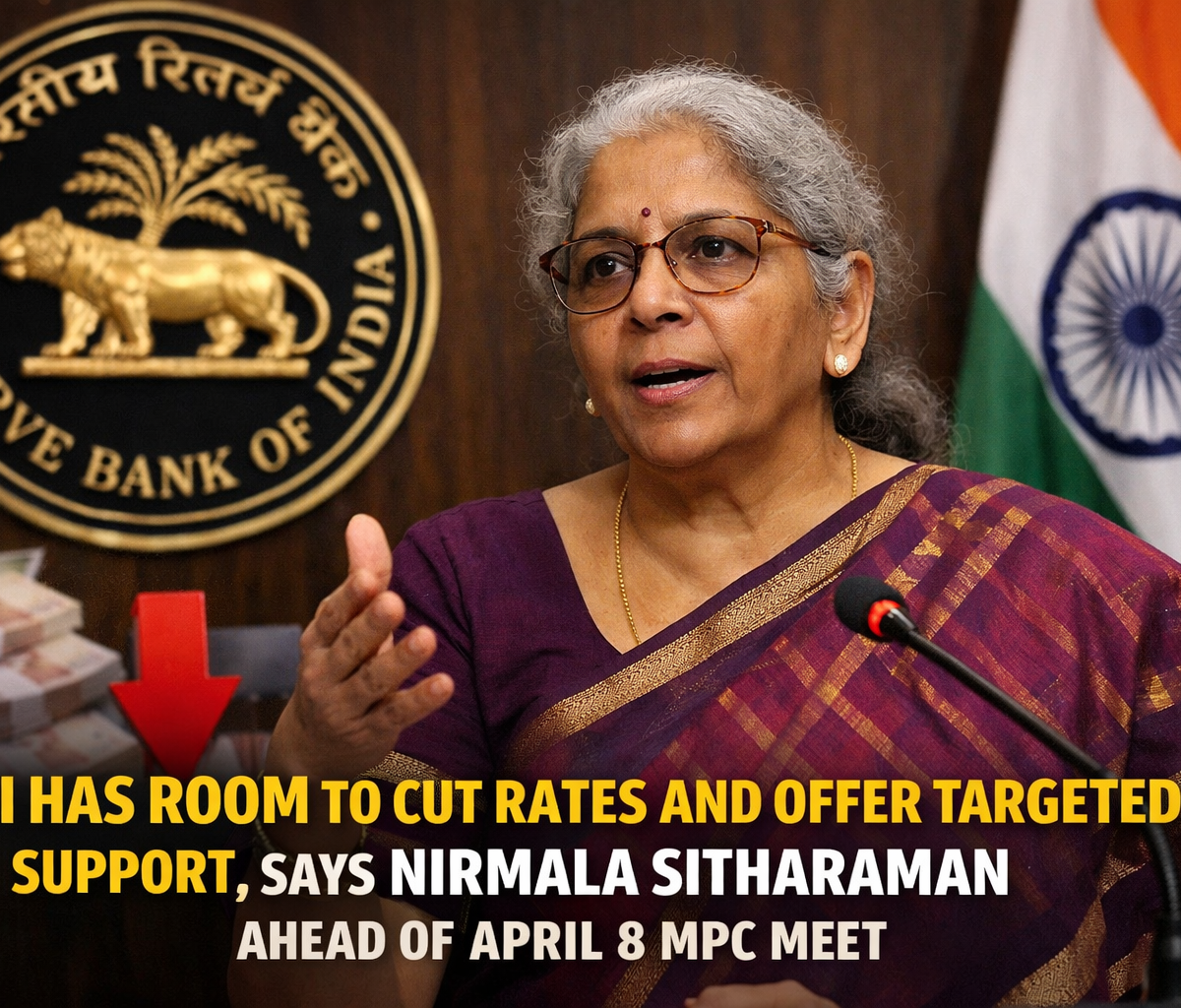
India’s financial markets are once again focused on the RBI as expectations build ahead of the upcoming Monetary Policy Committee meeting on April 8. This time, the spotlight grew stronger after Finance Minister Nirmala Sitharaman said that the Reserve Bank of India has room to reduce interest rates and extend targeted support to sectors that may be facing pressure.
Her remarks come at a crucial time. The global economy is dealing with uncertainty, geopolitical tensions are adding pressure, and the Middle East conflict is now raising concerns about energy supply chains and inflation risks. At the same time, India is trying to stay on its long-term growth path under the Viksit Bharat vision.
So, what does this mean for borrowers, investors, businesses, and the broader economy? Will the RBI cut rates again, or will it pause and wait for more clarity?
In this article on Newzeefy, we break down everything you need to know in simple terms.
Nirmala Sitharaman Signals RBI Has Room to Act
Speaking at a NIPFP event, Finance Minister Nirmala Sitharaman said the RBI has room to lower interest rates and also provide focused support to sectors that may be under stress.
That statement is important because it comes just before the April 8 Monetary Policy Committee meeting, when the central bank will decide whether to change the repo rate or keep it unchanged.
According to Sitharaman, the central bank is in a position where it can consider both:
- Cutting interest rates
- Providing targeted relief to affected sectors
This comment has immediately caught the attention of economists, market participants, and ordinary borrowers.
For readers following business and policy developments, you can also explore more updates in the Trending News section on Newzeefy.
What Did the Finance Minister Actually Say?
The finance minister said that the RBI can cut interest rates and has room to offer targeted support to affected sectors. Her broader message was that India must remain flexible in handling economic policy because the global environment is becoming more difficult.
She also said public borrowing strategies would need to be “smart” in light of current headwinds.
That matters because it suggests the government is aware that economic management in 2026 will require balancing several pressures at once, including:
- Global uncertainty
- Domestic growth needs
- Inflation risks
- Geopolitical tensions
- Monsoon-related concerns
Her statement was not a direct instruction to the central bank, but it clearly indicates that the government sees room for supportive monetary action if needed.
Why the April 8 RBI MPC Meeting Matters
The upcoming meeting of the RBI Monetary Policy Committee (MPC) is especially important because markets are divided over what the central bank may do next.
Key questions ahead of the meeting:
- Will the RBI cut the repo rate again?
- Will it pause because of global uncertainty?
- Will it announce sector-specific support measures?
- How will it react to the Middle East crisis and energy risks?
The policy decision will influence:
- Home loan EMIs
- Personal loan rates
- Business borrowing costs
- Fixed deposit returns
- Bond yields
- Stock market sentiment
In short, the April 8 meeting could have an impact far beyond banking circles.
A Quick Look at the RBI’s Recent Repo Rate Moves
The RBI last cut the repo rate on December 5, 2025, when it reduced the benchmark rate by 25 basis points, from 5.50% to 5.25%.
That was part of a broader easing cycle through 2025. In total, the central bank had already delivered 125 basis points of cumulative rate cuts before pausing in February.
RBI rate trend in recent months:
- Repo rate was cut gradually through 2025
- Total easing reached 125 basis points
- Last cut came in December 2025
- February policy review saw a pause
- Current repo rate stands at 5.25%
At that time, RBI Governor Sanjay Malhotra described the economy as being in a “Goldilocks” phase — a situation where growth is healthy and inflation remains manageable.
But conditions are changing.
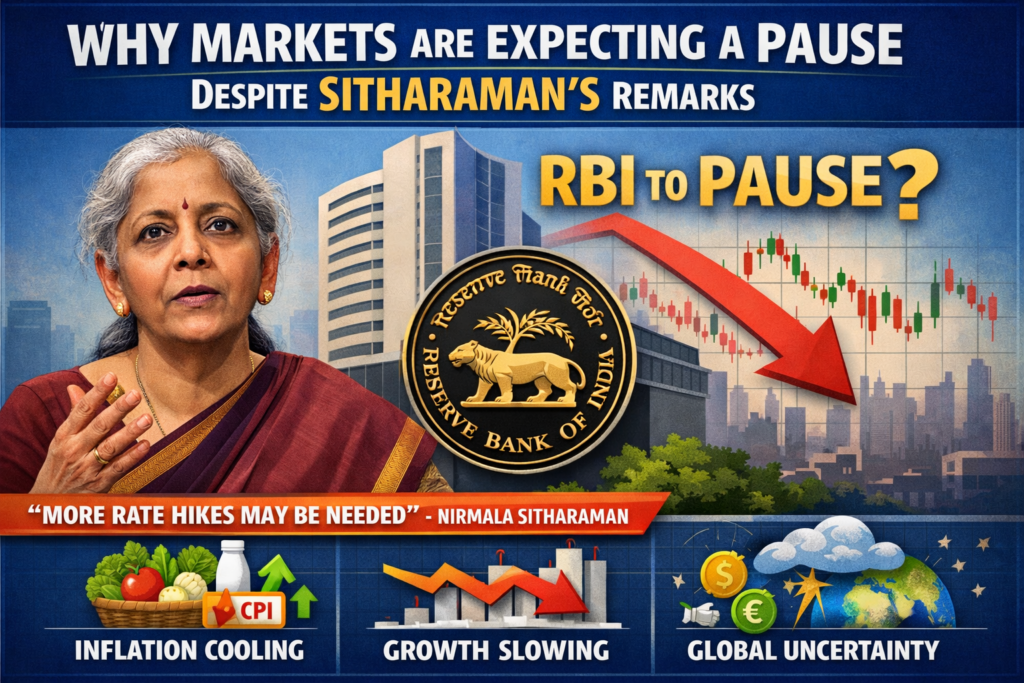
Why Markets Are Expecting a Pause Despite Sitharaman’s Remarks
Even though the finance minister said the RBI has room to cut rates, many economists believe the central bank may choose to wait.
According to a recent Reuters poll, most economists expect the RBI to keep the repo rate unchanged at 5.25% in the upcoming meeting.
Why analysts expect a pause:
- The Iran conflict has increased global uncertainty
- Currency markets have become more volatile
- Bond markets are reacting to geopolitical risks
- Oil prices may rise if Middle East tensions worsen
- The RBI may prefer caution before making another move
This is a classic case of policy flexibility versus policy caution. The RBI may have room to cut, but whether it chooses to use that room right now is another question.
Global Challenges Are Becoming Harder to Ignore
One of the strongest points made by Sitharaman was that the global economy is facing serious uncertainty.
She described the world economy as witnessing:
- Volatility
- Uncertainty
- Complexity
- Ambiguity
These are not just broad economic buzzwords. They reflect the type of environment where central banks must be extra careful.
When external risks are high, monetary policy becomes more difficult because central banks have to balance domestic needs with global shocks.
For example:
- Lowering rates can support growth
- But lower rates may also weaken the currency
- Global tensions can push oil prices up
- Higher oil prices can raise inflation
- Inflation can reduce the room for rate cuts
That is why the RBI faces a delicate balancing act.
Middle East Conflict Is Now a Major Concern
Sitharaman specifically highlighted the Middle East conflict as a growing risk to the global economy.
She said the conflict has evolved into a “systemic tremor” that could threaten vital global energy supply chains.
That warning matters because India imports a large part of its energy needs. If global energy supplies are disrupted, it could lead to:
- Higher crude oil prices
- Increased fuel costs in India
- Rising transport costs
- Pressure on inflation
- A weaker rupee
- Reduced room for monetary easing
For broader international context, readers can also track global business and geopolitical coverage from sources like BBC News and Reuters.
What Does “Targeted Support” Mean?
One interesting part of Sitharaman’s comment was not just about rate cuts, but about targeted support.
This could mean support for sectors such as:
- MSMEs
- Export-driven businesses
- Agriculture-related industries
- Manufacturing segments under stress
- Sectors affected by borrowing costs or global disruptions
Targeted support usually refers to steps that help specific parts of the economy without making broad changes for everyone.
This may include:
- Better liquidity support
- Regulatory easing
- Credit availability measures
- Special refinancing windows
- Sector-specific lending support
If the RBI feels broad rate cuts are too risky at the moment, it may still explore such focused measures to help stressed areas.
How an RBI Rate Cut Could Affect You
For ordinary people, the RBI decision matters most when it affects daily finances.
If RBI cuts rates, borrowers may benefit through:
- Lower home loan EMIs
- Reduced personal loan interest
- Cheaper business loans
- Improved credit affordability
But savers may see:
- Lower FD rates over time
- Reduced returns on savings-linked products
That means the impact depends on whether you are primarily a borrower, saver, or investor.
For many families, even a small rate cut can provide some relief on monthly EMI payments. But for retirees and conservative investors, falling interest rates may not always feel like good news.
Why the “Goldilocks” Phase May Be Under Pressure
Earlier, RBI Governor Sanjay Malhotra had said the Indian economy was in a “Goldilocks” phase — not too hot, not too cold.
That usually means:
- Growth is strong
- Inflation is under control
- Policy conditions are supportive
However, that balance may now be under stress due to:
- Rising geopolitical tension
- Energy supply worries
- Currency volatility
- Uncertain external demand
- Possible inflation pressures
So while the Indian economy may still be relatively stable, the environment around it is becoming more challenging.

India’s Growth Vision and the Role of Smart Borrowing
Sitharaman also said that India’s growth vision under Viksit Bharat must deal with both external and domestic factors.
These include:
- Global market instability
- Middle East tensions
- Public borrowing needs
- Domestic weather concerns like monsoon performance
- Investment demand
- Consumption trends
Her mention of “smart” public borrowing strategies is significant. It suggests the government wants to carefully manage debt and fiscal planning while keeping growth momentum alive.
This is important because monetary policy alone cannot do all the work. Fiscal policy and borrowing strategy also shape the broader economic outcome.
What Economists Will Watch in the RBI Policy Statement
Even if the RBI does not cut rates on April 8, markets will still closely read the tone of the policy statement.
Key things economists will watch:
- Whether the RBI sounds dovish or cautious
- Inflation outlook for the coming months
- Any mention of oil prices and external risks
- Guidance on liquidity and sector support
- Growth projections for India
- Future rate cut signals
Sometimes the language of a central bank matters just as much as the actual policy move.
A pause with supportive commentary can still be seen as positive by markets. On the other hand, a cautious statement may reduce hopes for near-term easing.

What Borrowers, Investors, and Businesses Should Expect
At this point, the situation remains fluid. The RBI may have room to cut rates, as Sitharaman suggested, but it also has enough reasons to stay cautious.
For borrowers:
Watch for possible future EMI relief, even if not immediate.
For investors:
Expect market volatility around the policy announcement.
For businesses:
Keep an eye on liquidity support and sector-specific measures.
For savers:
Be prepared for possible changes in FD rate expectations if easing resumes later.
In other words, the next RBI move will matter, but the guidance around that move may matter just as much.
Why This RBI Meeting Is More Important Than Usual
This is not just another routine policy meeting. The April 8 review comes at a time when several pressures are meeting at once:
- A shifting global economy
- Geopolitical tensions
- Energy risks
- Domestic growth ambitions
- Inflation management needs
That is what makes this meeting especially important. Whether the central bank chooses to cut, pause, or signal targeted support, the decision will shape expectations for the next phase of India’s economy.
For more updates on business, policy, and market developments, readers can always check the latest stories on Newzeefy.
Conclusion
Finance Minister Nirmala Sitharaman’s remarks have added fresh interest to the upcoming RBI Monetary Policy Committee meeting. By saying the Reserve Bank of India has room to cut rates and provide targeted support, she has signaled that monetary policy still has flexibility even in a difficult global environment.
At the same time, the backdrop is far from simple. The Middle East conflict, energy supply concerns, market volatility, and inflation risks all make the RBI’s job more complicated. That is why many economists still expect a pause at 5.25%, despite the room for possible easing.
For borrowers, investors, and businesses, the upcoming policy review could be important not just for what the RBI does, but for what it says next. Will it cut rates, hold steady, or open the door to targeted support? The answer will help shape India’s financial mood in the weeks ahead.
As always, the smartest way to follow the story is to stay informed, watch the signals closely, and understand the bigger picture behind the headline.
FAQ
Will RBI cut interest rates in the April 8 MPC meeting?
The RBI may cut rates, but many economists expect it to keep the repo rate unchanged at 5.25% because of global uncertainty and geopolitical risks.
What did Nirmala Sitharaman say about RBI?
Nirmala Sitharaman said the RBI has room to lower interest rates and offer targeted support to sectors facing stress.
What is the current RBI repo rate?
The current RBI repo rate stands at 5.25% after the last cut made in December 2025.
How does an RBI rate cut affect home loans?
If the RBI cuts rates, banks may reduce lending rates, which can lower home loan EMIs for borrowers.
Why are markets expecting RBI to pause rates?
Markets expect a pause because of global volatility, the Iran conflict, oil price concerns, and pressure on currency and bond markets.