

Iran announced three requirements for an end to their ongoing conflict with both the United States and Israel, bringing major attention from all over the world. Diplomats, analysts and millions of regular people have one question on their mind: What are these three requirements? Could they actually end the violence?
If you follow what’s happening in the Middle East currently, you already know that it’s one of the most volatile places in the world, geopolitically speaking. When the Iranians make one statement, it can have consequences in oil prices worldwide, ultimately changing military strategies around the world and even impacting global technology supply chains.
This article will break down all three requirements into easy-to-understand terms (no fancy diplomatic language). You will understand what the three conditions are, the political reasoning behind each one and how they might impact global stability.
Key Highlights
- Following the announcement of three pre-conditions by Iran for a ceasefire of the war between Iran and the USA/Israel, being recognition of Iran’s rights, reparations, and security guarantees; there is much international interest, because of the possibility that this war may have an effect on oil prices and world security, and experts anticipate that negotiations may change the dynamics in the Middle East; it may also depend on if diplomacy is handled well, and how will they affect whether tensions become worse or not.
For more global geopolitical updates, you can also explore
Why “Iran Sets 3 Conditions to End War With US and Israel” Matters Globally
When people read Iran US Israel war latest news, many assume it’s simply another regional conflict. In reality, There are bigger problems on the horizon.
Here are some reasons why the stakes are so high:
Approximately 30% of the oil in the world is produced from the Middle East.
If military actions escalate between nations, it could disrupt global energy markets.
All of the world’s superpower nations (United States, Russia, and China) are watching what is happening on the ground.
How the
political situation plays out will have implications for diplomacy throughout the region.
Similarly, the ripple effects from disruptions to the semiconductor shipping routes and global supply chains that pass through this same region (and potentially even further) will have effects on tech industry.
As a result, the conflict will not simply be political in nature, it will also be economically driven.
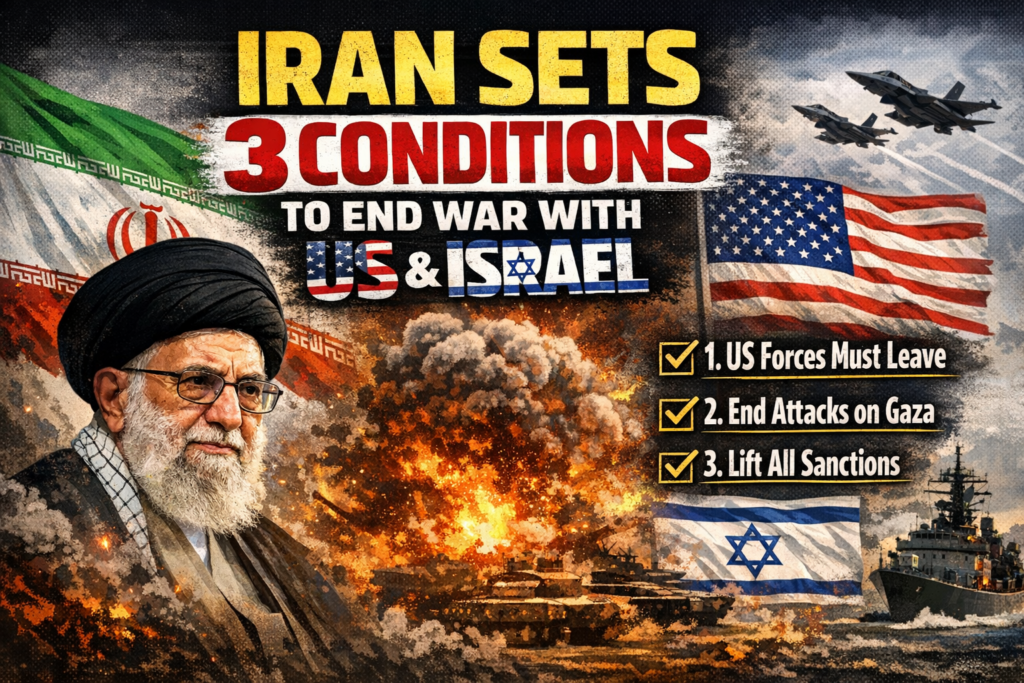
Iran Sets 3 Conditions to End War With US and Israel – The Three Demands Explained
When Iran announced its conditions, it wasn’t random political messaging. Each demand carrie strategic importance.
Let’s break them down clearly.
1. Recognition of Iran’s Sovereign Rights
A major element of Iran’s requests is to have diplomatic recognition from the world at large, particularly from the US and Israel, of Iran’s rights as a sovereign nation.
These rights include:
-Rights to control the region and act as a sovereign government
-Able to have foreign relations free from interference
-Able to provide its own security, without needing help from other nations
This is important because sovereign nations typically consider recognition by other sovereign nations as evidence of being a legitimate nation-state and having the legitimacy to negotiate with each other. So recognition must be provided in order to allow negotiations to take place.
Think of this as negotiations in the business world; you cannot negotiate with anyone until both parties agree to
and recognize each other as equal participants in the negotiations.
2. Compensation for War Damage
Iran bases its argument for reparations on the impact of military operations on their economy and government infrastructure.
This will lead to Iran seeking monetary compensation for damages, including:
Energy infrastructure
Military Facilities and Equipment
Civilian infrastructure
Some forms of international law provide for certain reparations after the end of hostilities; however, reparation discussions following conflicts tend to be incredibly complicated.
For example, postwar reparations in Europe took many years to achieve through negotiation before agreements were reached.
3. Guarantees Against Future Aggression
The third demand could prove to be the most significant of the three demands.
Iran’s third item is that they request international assurances that any further attacks will not occur.
This could involve things such as:
-Formal treaties
-Security guarantees from major powers
-International monitoring
The Iranian viewpoint is that, without security guarantees, any potential cease-fire will most likely be short-lived.
From a geopolitical strategy standpoint, this precondition is aimed at ensuring long-term stability.
Iran US Israel War Latest News: Why Tensions Escalated
There is no shortage of people asking themselves why tensions are at this stage.
The majority of readers probably feel overwhelmed due to the continual barrage of news.
Here is a simple timeline to follow.
The root causes of escalation
Long term political rivalry between nations in this area
Military interactions with retaliatory actions
Political issues about nuclear weapons and programs
Alliances and counter-alliances in Middle Eastern countries
The combination of these factors produced a situation that made any diplomatic/relationship-based trust very weak.
How the World Is Reacting
Global reactions to the announcement vary widely.
Some leaders see the conditions as a potential starting point for negotiations.
Others believe the demands may complicate peace talks.
Reactions from international observers
- Diplomats say negotiations could open new channel for peace.
- Military analysts warn tension remain extremely high.
- Economists monitor potential impacts on global oil market.
You can also track similar geopolitical analysis on
👉 Trending News
👉 Technology Trends
👉 AT News
👉 Politics News
👉 World News
👉 Newzeefy

Could These Conditions Actually End the War?
The majority of readers are likely to ask this question.
This question has no easy response.
Diplomatic discussions are rarely linear.
A number of experts have pointed out multiple challenges.
The following are the primary obstacles to reaching peace:
Distrust between nation(s)
Political pressures on politicians inside a country
The existence of strategic military alliances
Imposition of international sanctions
Despite many years of diplomatic negotiations, reaching final agreements can take quite a while.
Many historical cases exist that demonstrate that negotiations have ultimately worked out after many years of diplomacy.

Real-World Lessons From Past Conflicts
This is the common inquiry by many readers.
The actual situation is complex.
Typically, diplomatic negotiations will not occur smoothly.
Experts expand on these several difficulties.
1) Many significant barriers to attaining lasting peace.
2) Distrust among nations on a political level.
3) Pressure by domestic politics on governing officials.
4) Global military alliances.
5) Global economic sanctions on countries.
Even if a peace process begins, it can take several years to obtain a final agreement.
History gives good examples of the number of times negotiations were successful because it took a long time to achieve the result through diplomatic means.
Why You Should Pay Attention to This Story
YMaybe you are wondering why we should care about international events on a daily basis? The basic reason is that world politics have an impact on such things as:
The price of oil
Stock prices
Technology supply chain
The safety of traveling abroad
For anyone in the fields of technology, finance or doing business around the world being aware of the world’s political situations becomes extremely important.
Being up-to-date on the happenings globally will help you to grasp how global events will affect you and the market you are involved in.
The Future of the Conflict
We cannot know the exact end result at this time.
However, there are many expected different scenarios.
The following are possible future scenarios:
- Multilateral diplomatic negotiations with international mediators
- Temporary ceasefires
- Continued regional tensions
The direction that the situation goes in the future will largely depend on how the global powers are responsive.
Final Thoughts
Iran has laid out three conditions for the resolution of its ongoing conflict with the United States and Israel, triggering significant debate throughout the this conflict already.
Some analysts believe these demands represent a certain amount of strategic negotiation ambiguity, whilst others believe the terms represent an extremely difficult diplomatic precedent; however, irrespective of your perspective on this matter, this development illustrates the still-ongoing fragility of the modern geopolitical balance throughout the Middle East.
Keeping current on the latest development on the Iran US Israel Conflict will help you keep current not only with respect to global politics, but also with respect to the impact that mutually exclusive scenarios create in terms of impacting an economy or technology or overall global security.
In today’s heavily globalized, interconnected society and economy this understanding is perhaps more important today than at any other time in our life!
FAQ
What are the 3 conditions Iran set to end the war?
Iran demanded recognition of its sovereign rights, compensation for war damage, and guarantees against future attacks from the US and Israel.
Why did Iran announce these conditions?
Iran says the conditions are necessary to ensure long-term peace and security in the Middle East region.
How has the world reacted to Iran’s demands?
Global leaders and analysts have mixed reactions, with some supporting diplomacy while others remain skeptical.
Could these conditions lead to peace?
Peace negotiations are possible, but diplomatic agreements usually take time and involve multiple international stakeholders.