
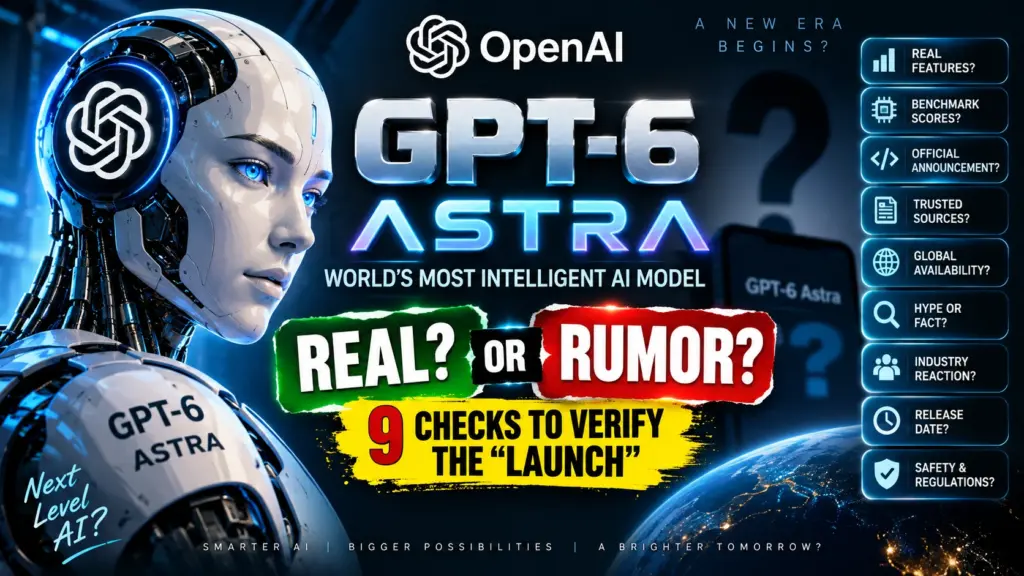
GPT-6 Astra: World’s Most Intelligent AI Model shows up all over TikTok, X threads, and “leaked” screenshots right now. GPT-6 Astra: World’s Most Intelligent AI Model also does not appear in any official OpenAI announcement or documentation as of my last verified sources (Aug 2025)—so treat “Astra” as unconfirmed / rumor until OpenAI publishes it.
That probably isn’t the answer you wanted… but it’s the answer you need if you care about your career, your product roadmap, and your credibility. You don’t want to pitch your boss (or your clients) on a model that doesn’t exist. 😅
Still, you can absolutely use this moment to get ahead: below you’ll find how to verify any OpenAI GPT-6 Astra Launch claim, what a real next-gen model launch usually includes, what “world’s most intelligent” should mean in practice, and how you can prepare your skills and systems so you can move fast when the next model actually drops.
- Today’s Live Gold Price
- Today’s Live Silver Price
- Today’s BSE Sensex Live
- Best AI 2026
- Future Technology 2030
Key Highlights (read this first) ✅
- No official OpenAI source confirmed “GPT-6 Astra” (as of Aug 2025). Treat it as unverified until OpenAI posts it.
- You can verify any OpenAI GPT-6 Astra Launch in under 2 minutes by checking a short list of official channels.
- Real launches usually ship with: docs + pricing + model card/system card + safety notes + API identifiers.
- The smartest teams don’t wait for a new model—they build evaluation, security, and deployment pipelines now.
- AI adoption already moved from “experiment” to “strategy”: McKinsey reported 55% of organizations used AI in at least one business function (2023).
GPT-6 Astra: World’s Most Intelligent AI Model — What’s Actually Confirmed? 🔍
Let’s separate signal from noise.
What you can say with confidence (fact-checked)
- OpenAI publicly releases model updates through its official blog and documentation.
- As of Aug 2025, OpenAI had not published anything official about “GPT‑6” or an “Astra” variant in the places that matter (blog, docs, API model list).
Use these official sources to verify:
- OpenAI blog
- OpenAI documentation (models + API)
- OpenAI status page (release-related incidents sometimes show here)
If a “launch” claim doesn’t show up there, you should label it as:
- rumor
- leak (unverified)
- speculation
Not “released.” Not “confirmed.” Not “world’s most intelligent.”
Why the “Astra” rumor spreads so fast
People want a clean storyline:
- “GPT-4 was big.”
- “GPT-5 must come next.”
- “GPT-6 Astra must be the super-intelligent one.”
Add a fake screenshot and a confident thread, and suddenly a lot of people feel pressure to “keep up.” If you feel that pressure, that’s normal. Most developers and PMs feel it too—because AI news moves faster than procurement, compliance, and real shipping timelines.
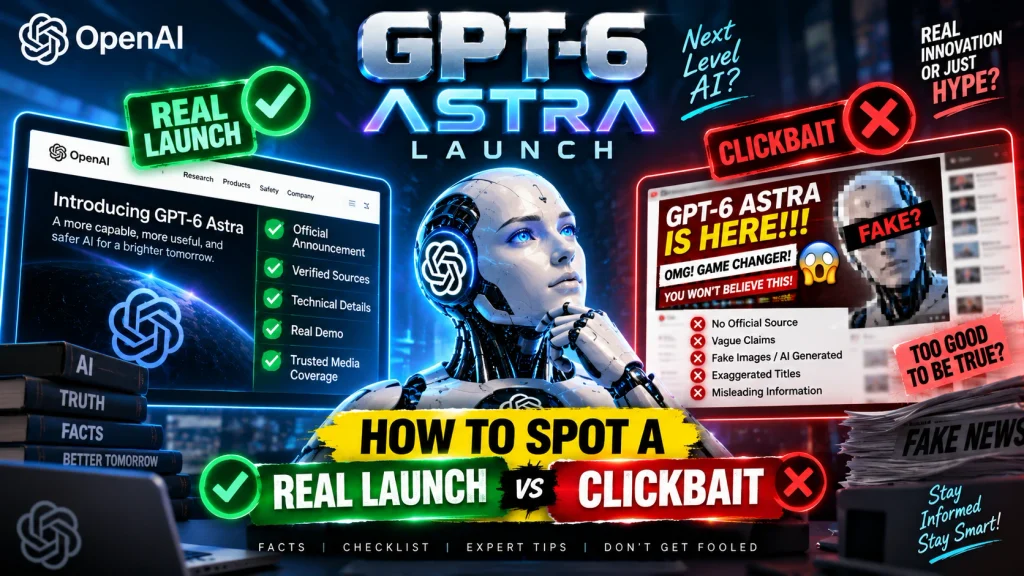
OpenAI GPT-6 Astra Launch: How to Spot a Real Launch vs. Clickbait ⚠️
You don’t need insider access. You need a checklist.
A real OpenAI model launch usually includes (look for these artifacts)
- Model name in official docs (exact API identifier)
- Pricing page updates
- Model card / system card (capabilities, limitations, safety work)
- Changelog notes or release notes
- Updated policy / safety language for new capabilities
If a post says “OpenAI launched GPT-6 Astra” but can’t show:
- the model ID,
- the pricing, and
- a link to OpenAI’s domain,
…you should assume someone farms engagement.
Quick “authenticity test” you can run in 30 seconds
Ask this in your head:
- Does the claim link to openai.com or platform.openai.com?
- Do multiple reputable outlets cite direct OpenAI statements (not “sources say”)?
- Can you find the model in the official models list?
If the answer stays “no,” don’t stake your roadmap on it.
What “World’s Most Intelligent” Should Mean (in Real Work)
Marketing language means nothing unless it changes outcomes.
When people claim GPT-6 Astra: World’s Most Intelligent AI Model, you should ask: intelligent how?
Useful ways to measure “intelligence” in AI (practical, not philosophical)
- Reasoning under constraints: Can the model follow rules without “creative drifting”?
- Tool use: Can it reliably call APIs, run code, and handle failures?
- Long-context performance: Can it read a large spec and stay consistent?
- Coding ability: Can it fix bugs without breaking adjacent systems?
- Factuality + citation discipline: Can it quote sources and refuse to invent?
In real teams, “smarter” usually means:
- fewer retries
- fewer hallucinations
- better structured outputs
- better reliability under load
- lower cost per useful task (because you stop re-running prompts)
Real-World Use Cases People Expect from a “GPT-6-Level” Model 🚀
Even if “Astra” never exists, the direction stays predictable: better reasoning, better tool use, better multimodal work.
Here’s where next-gen models tend to hit hardest:
1) Software engineering: from autocomplete to “pull request partner”
Use cases that create real value:
- Generate tests that match your team’s style and edge cases
- Draft migration plans (framework upgrades, API version bumps)
- Explain legacy code so new devs ramp faster
- Propose small PRs with safer diffs (refactors, renames, doc fixes)
A key stat you can cite internally: GitHub reported developers completed coding tasks 55% faster in a controlled study with Copilot.
2) Customer support: better answers without brand risk
- Summarize tickets
- Draft responses that match tone guidelines
- Pull policy snippets from your knowledge base
- Escalate with context (logs, user plan, last actions)
Best practice that actually works: RAG (retrieval-augmented generation) with strict quoting. You force the model to answer from your docs and show citations.
3) Data work: “explain this chart” plus “write the query”
- Turn “What happened last week?” into a SQL query draft
- Generate narrative insights for exec updates
- Flag anomalies (then ask a human to confirm)
4) Security + IT operations: faster triage, not automated chaos
- Summarize incident timelines
- Extract IOCs (indicators of compromise) from logs
- Draft remediation steps
Important: teams keep a human in the loop because security automation can burn you fast.
5) Learning + career acceleration
This matters if you feel behind.
A strong model can:
- coach you through system design interviews
- generate practice tasks and grade your answers
- explain a new framework with examples tailored to your stack
Best Practices That Future-Proof You (Even Without an OpenAI GPT-6 Astra Launch)
You don’t win by chasing model names. You win by building a system that handles any model upgrade.
1) Build an evaluation harness (so you stop arguing by vibes)
Smart teams run evals before they switch models.
What you evaluate:
- accuracy on your real tasks
- formatting reliability (JSON schemas, tool calls)
- refusal behavior (safety constraints)
- latency and cost
Why it works: you replace “this feels better” with measurable outcomes.
Internal guide idea: LLM Evaluation Checklist
2) Use RAG with citations for anything factual
Don’t ask a model to “remember” your policies. Feed them.
Why it works: you reduce hallucinations and you keep answers auditable.
Internal tutorial idea: RAG Tutorial: Build a Knowledge Chatbot
3) Lock down data boundaries (especially at work)
Best practices you can apply today:
- redact secrets before sending prompts
- separate environments (dev vs prod)
- log prompts with PII controls
- add allowlists for tools/actions
External reference: OpenAI API docs (privacy + data handling details live here): https://platform.openai.com/docs/
4) Design prompts like product requirements, not magic spells
A strong prompt acts like a spec:
- goal
- context
- constraints
- examples
- output format
- “what to do when unsure”
Internal guide idea: Prompt Engineering for Busy Developers
5) Put a human in the loop where mistakes cost money
Examples:
- legal text
- medical guidance
- financial actions
- security changes
- production deploy scripts
Why it works: you prevent high-impact failures while still saving time on drafts and analysis.
Career Angle: How You Can Benefit (Without Falling for Hype)
If you worry that you’ll miss the next big launch, focus on the skills that stay valuable across model generations.
Skills that hiring managers actually reward
- API integration (auth, rate limits, retries, error handling)
- Structured outputs (JSON schema validation)
- Tool calling (function design + safe execution)
- Evaluation (offline tests, regression tracking)
- Security + privacy basics
- Clear writing (prompts, docs, PRDs)
AI already impacts the job market because companies push automation and productivity. PwC estimated AI could contribute $15.7 trillion to the global economy by 2030 (a widely cited macro estimate).
If that number even lands partially right, companies will keep hiring people who can turn models into reliable products—not people who collect rumors.
Internal roadmap idea: AI Career Roadmap (Developer → LLM Engineer)
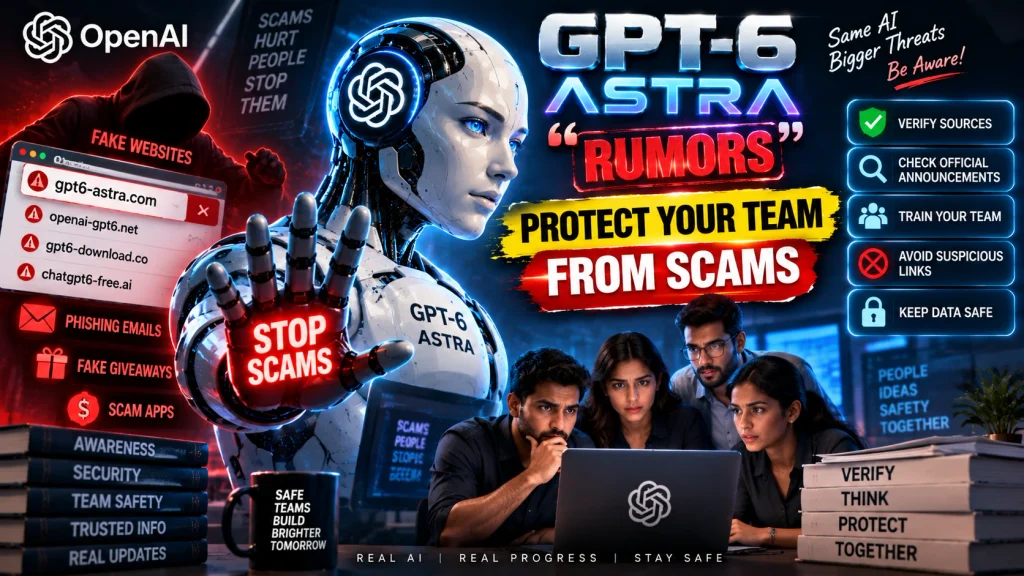
“GPT-6 Astra” Rumors: Protect Your Team From Scams 🧩
When hype spikes, scams follow.
Watch for:
- “Download GPT‑6 Astra.exe”
- “Chrome extension that unlocks Astra”
- “API key generator”
- fake GitHub repos that request secrets
Safer behavior:
- only use official OpenAI endpoints
- store keys in a secrets manager
- rotate keys after any suspicious activity
FAQ
Did OpenAI confirm GPT-6 Astra: World’s Most Intelligent AI Model?
No. As of Aug 2025, OpenAI did not publish official documentation or a blog post confirming “GPT‑6 Astra.” Check https://openai.com/news/ and https://platform.openai.com/docs/ for verified updates.
When will the OpenAI GPT-6 Astra Launch happen?
No official schedule exists for “GPT‑6 Astra.” Treat any date you see on social media as speculation unless OpenAI posts it.
How can you verify a real OpenAI model launch fast?
OpenAI News
OpenAI Docs / Models
Official pricing pages and changelogs (linked from the docs)
What features would make a next-gen model genuinely better?
fewer hallucinations
stronger tool use (reliable function calls)
better long-context consistency
better coding and debugging accuracy
lower cost per successful task
What should you do now if you want to stay ahead?
an evaluation suite
a RAG pipeline for factual answers
safe tool execution (allowlists + logging)
prompt templates and style guides
Then you can swap models without chaos.
Will a “GPT-6-level” model replace developers?
Companies will still need developers, but they will expect you to use AI effectively. GitHub’s research already showed big productivity gains with AI assistance. Developers who combine system design, integration skills, and evaluation discipline will stand out.
Final Take
You don’t need to panic-refresh for the OpenAI GPT-6 Astra Launch to protect your career. You need a calm, professional filter: verify sources, build durable AI workflows, and practice the skills that survive every model cycle.
If you want, share what you do (student, backend dev, PM, data analyst, support lead), and I’ll map the best “prepare-for-the-next-model” plan to your exact situation—without hype and without guesswork.

No comments yet
Be the first to share your thoughts on this article!Leave a Reply