

The future of technology is already influencing how people work, learn, build businesses, and make decisions about their future. What are Future Technology Trends 2026? Future Technology Trends 2026, also referred to as technology trends, are more than just names created by companies and showcased in tech expos. They are real-life and usable technologies, platforms, and innovations that will impact developers, startups, and businesses across the world.
Want to know the future of technology? Now is the best time to pose that question. The future of technology is evolving faster than ever. Every year, new technologies are being introduced, and the skillset that companies need is constantly evolving.
Rather than predicting what’s coming next, let’s look at the top Future Technology Trends 2026 that engineers, developers, and businesses are already planning for.
For more technology trends and updates, you can look at technology guides on
🔑 Key Highlights
- The use of AI for automation will revolutionize coding and business
- Edge computing will lead to reduced latency for real-time applications
- Quantum computing research will continue to gain pace
- The need for cybersecurity will grow with the rise in cyber threats
- Spatial computing and AR/VR will revolutionize digital interaction
- Green technology will be a new area for major investments
- Autonomous systems will go beyond the factory floor
- The development and implementation of 6G will start
The Technology Trends 2026 listed above are not just fantasies. Many multinational companies are investing billions of dollars on these technologies.
Why Understanding Technology Trends 2026 Matters

Technology change can be overwhelming.
Developers are concerned about the obsolescence of their skills. Students are concerned about the technologies that will be important in the next five years. Entrepreneurs are constantly concerned about where the next big thing will be.
This is perfectly normal.
But knowing the Future Technology Trends 2026 early on can be a huge advantage in your career.
“44% of the total skills of the workforce will change due to technological advancements by the year 2027.”
This is a big advantage in your career.
1. Artificial Intelligence Everywhere 🤖

Technology Trends 2026: AI Will Power Almost Everything
However, Artificial Intelligence is no longer limited to research laboratories. It is quickly becoming the backbone of modern software and digital systems.
Major technology companies such as:
are investing billions of dollars into AI infrastructure and research.
Real-World Examples of AI
Artificial Intelligence is already used in the following real-world applications:
- AI coding assistants
- automated customer support systems
- fraud detection platforms
- medical diagnosis tools
- content creation platforms
This means that, as a developer, coding will increasingly involve working with AI tools rather than being replaced by them.
Best Practices for Developers
To stay ahead of Technology Trends 2026, developers should:
- Learn the basics of machine learning
- Learn AI coding assistants
- Develop their problem-solving skills
However, modern companies want AI-enabled engineers, not just programmers.
2. Edge Computing Will Power Real-Time Apps
Future Technology Trends 2026: Edge Computing
ture Technology Trends 2026: Edge Computing
Traditional cloud computing sends data to centralized servers. While that works well for many systems, it becomes inefficient for real-time applications.
Edge computing processes data closer to the device itself.
Why Edge Computing Matters
Consider technologies like:
- self-driving vehicles
- smart cities
- industrial robotics
- AR and VR systems
These systems cannot wait seconds for cloud responses.
According to Gartner, 75% of enterprise-generated data will be processed at the edge by 2026.
(Source: https://www.gartner.com)
Real-World Use Case
A smart traffic management system can use edge computing to:
- analyze live traffic camera feeds
- detect accidents instantly
- automatically adjust traffic lights
This reduces response times from seconds to milliseconds.
3. Quantum Computing Breakthroughs
Quantum computing once sounded like science fiction. Today, it is becoming a serious research field with real-world potential.
Major technology companies involved in quantum research include:
Why Quantum Computing Matters
Quantum computers can solve problems that traditional computers struggle with, such as:
- drug discovery simulations
- logistics optimization
- climate modeling
- advanced encryption analysis
While most developers may not build quantum hardware, quantum programming frameworks will likely become a valuable future skill.
ture Technology Trends 2026: Edge Computing
Traditional cloud computing sends data to centralized servers. While that works well for many systems, it becomes inefficient for real-time applications.
Edge computing processes data closer to the device itself.
Why Edge Computing Matters
Consider technologies like:
- self-driving vehicles
- smart cities
- industrial robotics
- AR and VR systems
These systems cannot wait seconds for cloud responses.
According to Gartner, 75% of enterprise-generated data will be processed at the edge by 2026.
(Source: https://www.gartner.com)
Real-World Use Case
A smart traffic management system can use edge computing to:
- analyze live traffic camera feeds
- detect accidents instantly
- automatically adjust traffic lights
This reduces response times from seconds to milliseconds.
3. Quantum Computing Breakthroughs
Quantum computing once sounded like science fiction. Today, it is becoming a serious research field with real-world potential.
Major technology companies involved in quantum research include:
Why Quantum Computing Matters
Quantum computers can solve problems that traditional computers struggle with, such as:
- drug discovery simulations
- logistics optimization
- climate modeling
- advanced encryption analysis
While most developers may not build quantum hardware, quantum programming frameworks will likely become a valuable future skill.
Why Edge Computing Matters
Consider the following technologies:
- Self-driving cars
- Smart cities
- Industrial robots
- AR/VR systems
These systems cannot wait for seconds to respond from the cloud.
According to Gartner, 75% of enterprise-generated data will be processed at the edge by 2026.
Real-World Use Case
A smart traffic management system can use edge computing to:
- Analyze traffic camera feeds
- Detect accidents instantly
- Adjust traffic lights
This reduces response time from seconds to milliseconds.
3. Quantum Computing Breakthroughs
Quantum computers used to be the realm of science fiction. Today, they’re a legitimate area of research and have the potential to become a reality.
Some of the biggest companies currently researching quantum computers are:
Why Quantum Computing Matters
Quantum computers have the ability to solve problems that traditional computers have a hard time solving, such as:
- Drug Discovery Simulations
- Logistics Optimization
- Climate Modeling
- Encryption Analysis
4. Cybersecurity Will Become a Top Career Field 🔐

Technology Trends 2026: Cybersecurity Demand Is Exploding
The number of cyber attacks is rising with each passing year.
According to Cybersecurity Ventures, the damages from global cybercrime could hit $10.5 trillion per year.
This shows that cybersecurity is one of the most rapidly developing technological fields.
Why Companies Are Investing in Cybersecurity
The modern IT infrastructure is exposed to various threats such as:
- ransomware attacks
- data breaches
- AI-powered phishing attacks
- supply chain attacks
Cybersecurity Career Opportunities
The most sought-after job opportunities in the field of cybersecurity include:
- Security Analyst
- Penetration Tester
- Cloud Security Engineer
- Incident Response Specialist
Cybersecurity offers high demand, job stability, and strong salarie.
5. Spatial Computing and Mixed Reality
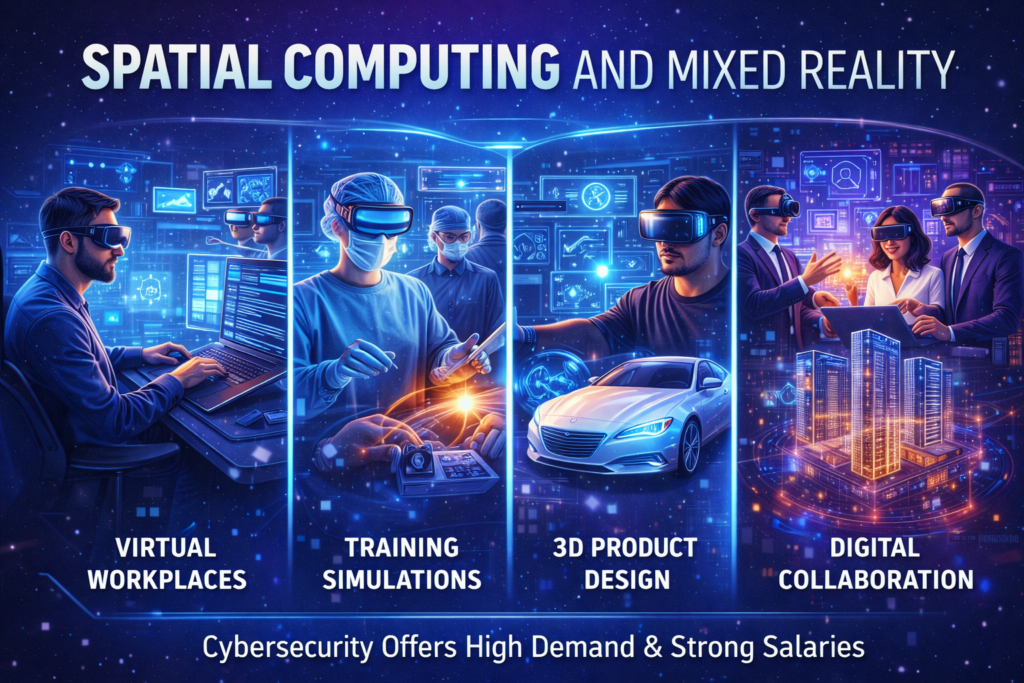
AR and VR are developing into a more general concept called spatial computing.
Major companies investing heavily in this technology include:
What Spatial Computing Means
It combines the physical world and digital environments.
Examples include:
- virtual offices
- immersive training simulations
- 3D product design systems
- collaborative digital workspaces
Real-World Example
Medical schools are already using VR surgery simulations to train students before real-world operations, improving safety and learning outcomes.
6. Green Technology and Sustainable Computing 🌱
Energy consumption through data centers is becoming a global problem.
Data centers consume around 1-1.5% of global electricity consumption, according to the International Energy Agency.
This has given rise to the advent of green technology and sustainable computing.
Examples of Green Technology
- Energy-efficient processors
- Carbon-neutral data centers
- Renewable-powered cloud services
- Optimized low-energy software systems
Developer are increasingly focusing on energy-efficient code and sustainable software engineering.
7. Autonomous Systems and Robotics
tics is growing beyond traditional manufacturing industries.
Some industries where AI-powered robots are used include:
- Logistics
- Agriculture
- Healthcare
- Construction
For instance, Amazon warehouse robots are already being used to store products.
Learn more technology innovations on
👉 https://newzeefy.com/
Benefits of Autonomous System
- reduced operational cost
- improved workplace safety
- increased productivity
This also creates demand for robotics engineers and automation specialists.
8. Ultra-Fast Connectivity: The Road to 6G
While 5G networks continue to roll out worldwide, the research for 6G technology has already begun.
The 6G network may offer the following improvements:
6G may deliver:
- Speed 100 times faster than 5G
- Near-zero latency
- Massive IoT connectivity
- The 6G network would enable the following
How Developers and Students Should Prepare
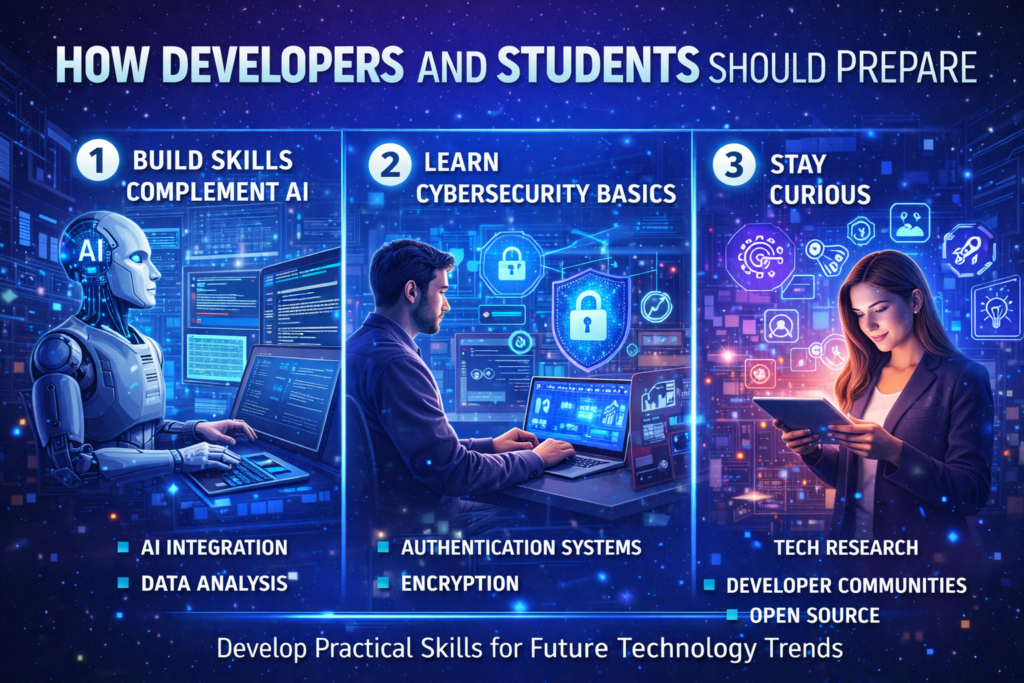
While learning about Future Technology Trends 2026 can be helpful, it’s what you do with that knowledge that counts.
1. Develop Skills That Will Supplement AI
This will include:
- AI integration
- data analysis
- system architecture
2. Learn the Fundamentals of Cyber Security
- authentication systems
- encryption
- vulnerability testing
3. Remain Curious
Technology is constantly evolving. To become the most successful person in your field, it’s essential to have the mindset to continually learn.
This means keeping up with:
- technology research publications
- developer communities
- open-source projects
You can also explore more technology insights on
👉 https://newzeefy.com/
Final Thoughts
However, the reality is that technology is advancing much faster than the majority of people expect.
As we look to the future and the Technology Trends 2026, it becomes very obvious that the future of Artificial Intelligence, automation, connectivity, and sustainability will shape the majority of the new technologies being developed.
As a student, a developer, or a budding entrepreneur, the exciting and daunting reality for you is that there is no right way.
The reality, though, is that if you remain interested and possess the right skill sets for the Future Technology Trends 2026, then the world of opportunities for you is limitless.
The future of technology is not about the technology; it is about people and how they can use the technology.
The best time to start preparing for the future of technology is right now.
Frequently Asked Questions (FAQ)
What are the biggest Technology Trends 2026?
The biggest Technology Trends 2026 include Artificial Intelligence (AI), Edge Computing, Cybersecurity, Quantum Computing, Robotics, Spatial Computing, Green Technology, and the Early Development of 6G Networks. These technologies have the ability to transform industries, businesses, and digital innovation.
Why are Technology Trends 2026 important?
The Technology Trends 2026 are significant in that they influence the job market, business strategies, and technology advancements. Understanding the Technology Trends 2026 will help developers, students, and organizations better prepare for the future and remain competitive in the dynamic cyber world.
Which technology careers will grow in 2026?
The jobs that are expected to grow as a result of Future Technology Trends 2026 include AI engineering, cyber security specialists, cloud engineers, robotics engineers, data scientists, and machine learning engineers.
How can students prepare for Future Technology Trends 2026?
Students can get themselves ready for the Future Technology Trends 2026 by learning programming skills, AI tools, cybersecurity basics, cloud computing, and data analysis. They can get themselves updated with the latest technologies and developer communities as well.